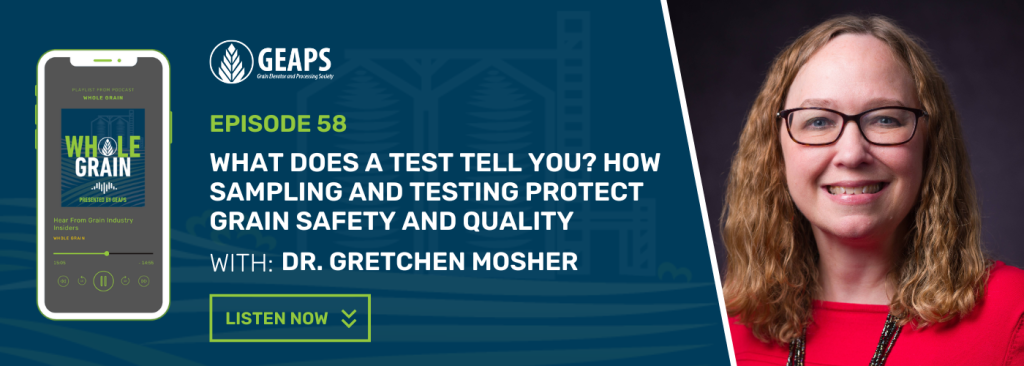
Jim Lenz, GEAPS:
Every day in this industry, millions of decisions are made about grain. Decisions about storing, blending, shipping, drying, feeding, and processing. But behind those decisions is something many people underestimate. Data. And in grain handling, one test or one mis test can change everything. In this episode of the whole brain podcast, we explore a topic that affects every elevator, every mail, every processor, and every safety manager. Sampling and testing shape the quality and safety of green. My guest today is Dr. Richard Walter, Associate Professor in the Department of Agriculture and Biosystems Engineering at Iowa State University, and one of the nation’s leading researchers in the measurement system, sampling carrying, quality management, and great feed. She joins me to break down what testing actually tells us why consistency matters. Garbage, garbage out, real facilities. And how even simple sampling practices can prevent quantity mistakes. Stay tuned. Hello and welcome to the show. You’re listening to the Whole Grain Podcast, where we explore the people, innovations, and ideas shaping the grain handling and processing industry. This show brings grain professionals together from 94 countries around the world. My name is Jim Lenz, your host and director of global education and training at GEAPS, where the mission of the Grain Elevator and Processing Society is to champion, connect, and serve the global grain industry and our members. Today we’re taking a deep dive into the world of sampling, testing, and data-driven decision making with Dr. Gretchen Mosher. Whether you run a country elevator, manage a terminal, operate a processing plant, or work in quality or safety, this episode will help you see your testing program perhaps in a whole new way. And as always, we’ll wrap up with reflection questions you can use with your team to turn today’s insights into action. All that and more coming up next. She advised her time between teaching research administration service. She spent her career exploring how we can improve safety and quality across the grain and feed industries. Dr. Mosher, welcome to the show.
Dr. Gretchen Mosher:
Thank you for having me, Jim. It’s a pleasure to be here.
Jim Lenz, GEAPS:
We are going to discuss the role of sampling and testing and managing safety and quality of green. Let’s start the big picture. An important part of managing and predicting the quality and safety of grain and feed products is testing. From your perspective, what’s the real value that testing provides to grain handlers?
Dr. Gretchen Mosher:
I think the primary value is the information that we get from the test, right? People make better decisions when they have better data and better information. And the test is kind of an all-in-one. You can get a lot of information from a very few number of tests that you can use to make storage, blending, end use decisions about commodity grain and oil seeds as they come into the elevator. So I think that’s the primary value, it’s the information that the test provides.
Jim Lenz, GEAPS:
Good to make decisions with sound data. Absolutely. When you speak with industry professionals, what are some of the more common, or at least maybe you’ve heard some common misconceptions you hear about testing?
Dr. Gretchen Mosher:
Well, I think many see testing as a way to catch them in a negative situation or potentially test for negative aspects in the grain or oil seeds. And I think I see it both ways. I think you also look for things that are where they should be, right? You’re verifying and validating that the grain you’re bringing in, the oil seeds you’re bringing in, fall within the parameters that you expect them to. And so it is a a bit about risk management too, right? And and you catch things early so you can keep them from becoming big things, right? When you test on a regular basis. I think the other misconception is that it is expensive. It is, it there is a cost, it is true, but it’s an investment and it’s really part of a larger quality management system is testing and the sample that is needed. Most tests in the grain and feed industry are non-destructive. Not all of them, it’s true, but many of them are. And so you’re not taking product out of commerce, right? You’re testing it, you’re putting it back in and running it through. And that’s another advantage, I think, when you’re working with non-destructive testing, like some of the examples I’ll talk about today. Those are the two primary misconceptions that I would like that I feel comfortable addressing.
Jim Lenz, GEAPS:
As you said, testing could be expensive. Certainly, there is an evolution of these automation sampling pieces of equipment that are out there. It’s pretty interesting how it’s done now compared to many times how it’s done in the past, although people aren’t all using automated procedures. But testing isn’t cheap. I mean, you need equipment, people, time. For those running elevators or processing facilities, why should they still consider investing in a testing strategy?
Dr. Gretchen Mosher:
I would argue the primary reason why folks should potentially invest in some form of testing strategy is the risk management potential. It doesn’t happen all the time, but generally, what has been characteristic of most large problems that are sourced out of grain-based ingredients, they started small. And had they been caught at the time that they initially surfaced, it would have been a fairly small amount of product to move out or to re-divert to a lesser, a less sensitive audience, if you will. And so being able to catch the small things before they become big things is the first thing. I also think with the regulatory compliance that we have now, post-FSMA, Food Safety Modernization Act, a testing plan represents the so-called due diligence that a firm or an organization performs so that they can say with confidence that things are clean, if you will. They are non-contaminated, the hazard is not present, the adulterant is not present, the quality factors are where they need to be for most optimal storage, handling, and processing. And so it is an investment, but it is a solid investment, I think, when you consider that the inventory that any given facility holds is at times millions of dollars in in inventory, right? So you’d like to know what’s up, you know, what’s up with that inventory. Does it fit where you’d like it to be or does it not? And if not, how far off does it deviate? Right. So those are all things, pieces of information that can be provided with a regular testing strategy.
Jim Lenz, GEAPS:
I like that you pointed that out, due diligence. So, yes, uh big component and rationale for developing that testing strategy. In your mind, when is testing most critical? Or is it critical during all stages? For example, you know, at harvest intake, during storage, or before a grain goes out the door?
Dr. Gretchen Mosher:
Good question. I think for certain, testing incoming product is something that you should be doing. And if you’re you’re measuring that incoming product as an elevator to determine where the discounts ought to be taken. So clearly, that’s a good time to take a sample. You have a good baseline for this is at receipt, right? So it wasn’t yours, now it is, it’s in your possession. So clearly, incoming product. But I would also say it does not hurt to take maybe a smaller number of samples of outgoing product. Again, particularly if you’re sending it up the supply chain or down the supply chain, if you will, to the vendor. And corn and oil seeds and soybeans and wheat change as they’re held in storage. And so you took that step of testing when it was incoming, depending on how long you have held it, it would make sense, in my opinion, to also test it on its way out, particularly if it’s headed somewhere where they’re going to look at the quality and they’re gonna say, you know, it doesn’t meet our standards, right? Or and I think if you have that record that says, in fact, it does, when it left our facility, here’s how we tested it, here’s where our data fall, here’s where those parameters are. I think it really gives you a good bargaining and leverage power uh when you’re working with vendors upstream to the next level.
Jim Lenz, GEAPS:
Excellent. Thank you for sharing. Something you’ve emphasized in your research is the importance of valid measurement procedures. Why is this such a big deal in our industry?
Dr. Gretchen Mosher:
I think that’s a a great question because when I teach undergraduates, I use a term with them related to quality protocols and data that says garbage in, garbage out, right? You really take care to have a high level of confidence in your results. To do that, you really need a sample that is taken in the same way again and again, right? The same protocol, the same methodology. When you use those standardized processes, you can have a higher confidence that when you do see differences or deviation from where it needs to be, you know that it’s actually the sample that is the problem, right? Not the fact that you had six different people testing it in six different ways, right? It is, you know, you know that those differences are actual differences based on the variability in the in the material rather than through measurement error, receiving error, you know, errors in in how people do things. And that’s important, uh, number one. And as an example, low-level analytes or things that we look for when we test adulterants or whatever that are non-uniformly distributed are highly influenced by sampling procedures. So when you change the way you sample, it could have a pretty large impact on the finding. And in the grain and oil seed handling industry, these types of low-level analytes that are non-uniformly distributed include big things, um, mycotoxin, genetic traits, foreign material, microbiological or microbiology contamination. All of these things are considered, with the potential exception of foreign material, are considered hazards, are often on the list of preventive controls for grain and feed handling industries. And therefore, the the sample protocol and measurement procedures are our big deal. Um, and when you do it the same way every time, you know that that that variability is not part of the equation. Uh, there’s always variability in processes and procedures. But even if you take care to minimize that, but minimizing that variability is critical to find the real differences, right? When they exist.
Jim Lenz, GEAPS:
That makes sense. What are some of the risks when a facility relies on poor sampling methods or uncalibrated equipment? You touched on this a little bit.
Dr. Gretchen Mosher:
I I did. I actually wrote a paper on this with my colleague u Charles Herberg and a graduate student, where we actually simulated what we called random and systematic error in our ability to segregate soybeans by geographic area. The the risk of a facility relying on poor sampling methods or uncalibrated equipment is that they risk make a large error in the decisions that they make. So, as I said earlier, I wrote a paper on this where we simulated uh random and systematic errors. Uh, we looked at its impact, the impact of those random and systematic errors on whether we could segregate and isolate and differentiate soybeans coming different uh geographic areas. Random errors include user errors, people doing different things, environmental effects, and equipment uh deterioration. That equipment deterioration could be the fact that the power source is uh not consistent and therefore the light is not consistent and it’s not measuring in the same direction. Those are random errors that do not occur with any kind of a routine way. Systematic errors include instrument measurement bias, so an instrument that reads not as accurately at higher levels of measurement, for example, or variances in how we standardize those instruments. So if we use different standardization sets of grain samples to standardize, there can be differences in readings across several locations. Those are systematic errors. Our simulation found that it can have a big impact on what the final result looks like and can muddy the waters even further in a situation where the differentiation is not always clear. Furthermore, sometimes errors that we think are random, meaning that they occur not on a regular pattern, are actually systematic, meaning environmental effects such as temperature or equipment deterioration could very possibly be based on what we call a non-random pattern. So this idea that these things are happening on a regular basis, and if you’re totally unaware of them, they’re influencing your decision making and you don’t even know it, right? You don’t even know that these things are happening. So good and valid sampling methods help not necessarily, it’s not going to say, oh, by the way, here’s your error, right? But when you see the behavior of the data when you use those those uh protocols, it should give you cause to pause, if you will, and think, I wonder what’s going on here. We usually see this. Today we’re seeing these things. What’s happening, right? And if you can say, I know that it is not my measurement protocol, it’s not the sampling technique, it’s not the testing technique, it’s got to be from somewhere else. And it really begins that root cause analysis on where the problem is. And without that or sampling, you must first rule out the sample, uh the sampling method, right? And that’s harder to do than more difficult than just finding, you know, finding the problem with the product. And that’s what you want to find, right? You don’t want to find that it’s just that you have not calibrated your instrument in you know for too long. And that’s why you you’re seeing these random or systematic errors.
Jim Lenz, GEAPS:
What advice would you give to an operations manager to ensure their testing process is consistent and reliable?
Dr. Gretchen Mosher:
Two things. First, I think it is really a good practice to take a composite sample, meaning a sample that’s got bits and pieces from each load that you’ve brought in, potentially in a five-gallon or a 10-gallon bucket, once or twice a day during times of low risk, just for maintenance samples. And then when the situation demonstrates a higher level of risk, compiling and testing several composite samples a day would not be outrageous, I don’t think. So that’s the first thing. Second, to consider a two-tiered approach. Determine a fairly straightforward and rapid, non-destructive measurement for all samples that you take, moisture or test weight or something that potentially could serve as an indicator that something else might be happening to kind of maintain and establish a pattern of what the product is looking like. And then if that first tier measurement reads outside of your parameters, you can set that sample aside for later, right? For further testing, maybe a more comprehensive or a more analytical or uh near infrared test for things, you know, like protein, oil, fiber, toxin, that type of thing. Because clearly you can’t do that while you’re receiving a lot of product at a time, as we do during harvest. So having that two-tiered approach, having one thing that you’re already going to collect and to use that as kind of your your indication that something else might be happening, and record that data. And then when things fall outside of that spectrum, test just a subgroup, a smaller subgroup of samples for the higher level tests would be my suggestion.
Jim Lenz, GEAPS:
That makes sense. Thank you. Let’s say you’ve run the test. Now comes a question what do you do with the data? How can grain handlers use that information, improve safety or product quality?
Dr. Gretchen Mosher:
Well, to begin, I will first uh share an analogy from a colleague of mine who said if you collect data and do not use it or do nothing with it, you might as well put a pile of money on the floor and light it on fire. And it is true, data are expensive, no matter what, right? Collecting the data are time consuming. And if you are not committed to using them, using the data results that you have for operational and daily decision making, why are you collecting it? Right. And to think about when you collect how long do you store things, how long do you keep stuff? Those are more sophisticated questions. But ultimately, commit to using that data to make operational decisions on a daily basis. For example, when and where and how long to store, um, how much to dry? Do we send it to the wet bin? Do we send it to the dry bin? In merchandising decisions, you know, when you’re loading the train, when you’re loading the truck, uh, what do we put in there to optimize blending and so on? Things like that. All of those decisions are data-based decisions. And when you collect the data that you need to make those decisions, it makes sense and it is logical that you will use the data that you collect. And that’s those are just a few suggestions on how to use the the data you collect on a on a daily, your kind of daily operational data.
Jim Lenz, GEAPS:
So that’s why you encourage using test data to support continuous improvement at first and facilities then?
Dr. Gretchen Mosher:
Exactly. Exactly. And I think there are a lot of facilities out there that are doing a great job with that. They they have a much better handle on what they have and how much they can blend and and what they can hold and what they can merchandise when they know what’s in their inventory. Again, it isn’t, you know, over a million dollars of inventory, at least at minimum, for most facilities. Keeping good care of that and managing it appropriately should be a priority.
Jim Lenz, GEAPS:
So let’s move the bigger picture, talk about, let’s talk about industry and regulatory connections. Beyond the day-to-day operations, what role does testing play in meeting regulatory requirements? I know you mentioned things like FSMA or other export market standards.
Dr. Gretchen Mosher:
That’s a good question. With FSMA, the test data that are collected, you know, at receipt provide some of the best proof, quote unquote, that an organization has thought through food and feed safety hazards at their facility and taken actions to both monitor and remove hazardous hazardous material as warranted. Further, when it doesn’t happen very often, and I know this, but outbreaks and recalls do occur. And when they do, your test data provide that solid documentation that your product potentially is not among that which is being recalled, right? That is one of the best cards you can hold in your hand, right? Is to lay that card on the table and say, we know that our product is not there because we’ve kept we’ve kept good track of it, right? And I think this is a good point to mention. It’s your processes that tell you that, right? Your documented processes that tell you where your product is and where it’s not. And sometimes where it is not is the more important designation that you can you can make. Is it we know it’s not here where all of these other recalled products are located, right? Your processes and the record of that process is is what you have. Uh and that is especially true, I think, with um export market standards, particularly as it relates to transgenic material and things like that. It is those records that provide you that documented data that you need to be able to say, hey exporter, here’s where we’ve held this. We have the records to demonstrate that we have held this non-genetically modified product in this bin. We’ve held these food-grade soybeans in this bin, which is a food grade bin. We have not put food grade or non-food grade things into the bin. We’ve not hauled in a container that is non-food grade. So we feel nearly positive that this these recalled things are not uh not among our products, right? Not we we did not contribute to this problem or something like that. But it provides a really strong hand to play.
Jim Lenz, GEAPS:
Yeah, good record keeping is critical.
Dr. Gretchen Mosher:
It is.
Jim Lenz, GEAPS:
Do you see testing practices changing in the future as technology advances? For example, real-time digital monitoring or automation.
Dr. Gretchen Mosher:
Absolutely. I think we we change practices all the time. I think an area of interest for me personally is kind of machine vision and and real-time sensoring and and uh monitoring, potentially with a bit of automation involved. Uh and I have no doubt that will probably change the sampling and testing practices. But I also would like to point out that we’re making the same decisions with the same data we’ve always had, right? It it is no matter how we measure that data, whether it’s through an automated sensor or with a human sensor, right? It it’s the same data. Uh that could change moderately, but I think the practice of removing the embedded errors in the sampling process is something that I see definite definite change. I’ve seen it even in the 15 years that I’ve been in this industry, that it has changed dramatically. And I expect we have more dramatic change on the way because given all the new technologies available.
Jim Lenz, GEAPS:
Yeah, that’s a good great uh offering there. And uh that makes me wonder. Not every listener has a large budget or access to cutting-edge labs. What are two or three practical steps that any facility, big or small, can take right now to improve their testing practices?
Dr. Gretchen Mosher:
That’s a great question. I would begin by saying even if you don’t have a lot of equipment, take care of the equipment you have, do the routine maintenance, do you know, perform the calibration procedures, ensure that the equipment you have is measuring things in a valid and accurate, precise way. Nearly all facilities have a moisture meter, for example, a moisture uh instrument. I don’t know the number who calibrate these instruments on a regular basis. And it makes a big difference in how well they read, right? And how well and how accurate those uh readings are. And when you ensure that that equipment is in is calibrated and in good working order, that’s the first step. That way, when you perform your test, you can feel confident that the data output is valid. Second, double dip on your data, use data you’re already collecting for operational reasons. Moisture, test weight, uh, grading factors like foreign material, broken kernels, that type of thing, damage. Use these measures as kind of that first tier operational decision, right? Um make a decision about where you’re going to put things and think about scenarios ahead of time. Where you where are you going to divert this load that has a lot of damage versus one that is a high moisture load or you know, whatever you’re looking at. Uh, when you take those initial samples, use that basic data that you have to predict larger, um kind of establish the patterns that you can expect. And so when you see something that is outside of that boundary, you can take action and investigate a bit. And finally, I think it is a good practice, and I will repeat this again, to take a composite sample even during times when the hazard level is low. Run your basic tests on that composite sample. And then if there’s no need to follow up, you know, record it, note, note it, and then if warranted, dump that grain back into the pit and go on with your day, right? If there’s a problem, then you keep the sample and you have it as your record. You don’t even need to necessarily test it that day, or maybe you send it off site for testing if you’re a small facility. But having the composite sample is a cheap way to uh ensure that the loads that have come through your facility are quote unquote clean. That is a really good practice and habit to get into is taking once or twice daily composite sample and just checking it, making sure there are no major problems. So those three things take care of the equipment, use your basic data, and then make that practice a habit of taking a composite sample once or twice a day.
Jim Lenz, GEAPS:
It’s terrific. Three big tips there for any operation and facility, regardless of budget, something that all can consider and implement. Now, Dr. Mosher, this has been incredibly insightful. Testing can sometimes feel like a burden, but you’ve really highlighted how it’s a critical tool for both safety and profitability in our industry. Before we wrap up, what’s one thing you’d like listeners to remember the next time they face a decision about testing at their facility?
Dr. Gretchen Mosher:
You have total control over the quality of your data. And people make better decisions when they use valid data to make those decisions. So utilize the inventory that you have and the data and information that it provides to make better decisions.
Jim Lenz, GEAPS:
That’s fantastic. Great advice, and others can implement this, our listeners. You’ve been a terrific guest in the Whole Grain Podcast. Thank you for joining us today.
Dr. Gretchen Mosher:
You’re very welcome.
Jim Lenz, GEAPS:
That brings us to the end of today’s episode of the GEAPS Whole Grain Podcast. A huge thank you to Dr. Gretchen Mosher for joining us and for sharing her expertise on one of the most critical and often overlooked aspects of grain operations, the role of accurate sampling and testing. As we heard today, reliable data doesn’t just protect product quality, it protects your inventory, your customers, your reputation, and your bottom line. A strong testing program is one of the best tools any facility can have for managing safety, reducing risk, and making informed decisions every single day. Before we wrap up, here are a few reflection questions you can discuss with your team. What data do we collect today? And are we actually using it to guide decisions? How consistent are our sampling procedures across ships, seasons, and employees? What risks could we? Reduced with more routine composite sampling or better calibration practices. Where does testing give us leverage with suppliers, customers, or regulatory records? And how can we strengthen that documentation? And finally, what small improvements to our current testing workflow could make the biggest impact? And remember, Jeeps is here to support your growth. Explore over 25 online and on-demand courses built for green professionals, hands-on training programs with industry experts, a searchable library that continues to grow, comprised of over 200 technical and operational videos, interactive webinars and maintenance state learning, our next gen path for interns and early career professionals, globally recognized credentials for emerging leaders and industry veterans, the GEAPS Digital Grain Glossary, local chapters for networking and professional development, and of course GEAPS Exchange, the industry’s premier annual event. Visit GEAPS.com, that’s GEAPS.com to learn more about how you can connect, grow, and stay ahead. I’m Jim Lenz, Director of Global Education and Training at GEAPS. Thank you for joining us, and until next time, keep feeding, fueling, and clothing the world.